What is a robotic surgical platform?
The Da Vinci system is one of several robotic surgical platforms, and the pioneer of the category. Comparable systems today include Hugo and Japan's hinotori.
These platforms offer two distinct instrument characteristics:
- Clear deep visualization: when working in deeper spaces such as the abdominal cavity, the system provides a magnified stereoscopic view — close to placing your eye directly beside the tissue.
- Wide joint articulation: the mechanical wrist can rotate a full turn and back, reaching angles a human wrist cannot achieve inside the body.
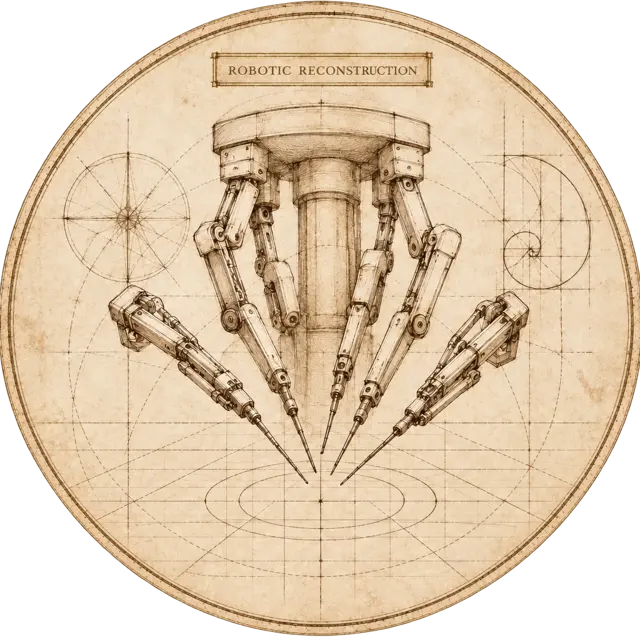
Together, these make the platform a genuinely useful tool for a surgeon in specific operative situations.
Why I do not start with a robotic platform
Using a robotic system carries several unavoidable prerequisites:
- The patient must receive general anesthesia with intubation.
- The operation requires a pneumoperitoneum, and because the robotic arms must enter the abdomen, the volume of insufflated gas is comparatively large, which also means more post-operative distension and discomfort.
- Suturing inside the body has operative limits, so most cases still require mesh reinforcement. A subset of smaller defects can be reconstructed and sutured from inside the abdomen without placing mesh, but those are relatively uncommon case conditions.
So whether a robotic platform is appropriate depends on the shape and size of the defect, the condition of the abdominal wall, whether entering the abdominal cavity is necessary at all, and the patient's overall health and anesthetic risk — not on how new the equipment is.
For some patients these prerequisites are worth accepting, because no other approach addresses their problem as completely. For others, the same treatment goal can be reached with a lighter burden. That judgment belongs in the consultation — you do not choose the device first and then look for an indication.
Where we actually use a robotic platform
1. Complex or large abdominal wall hernias
The most common scenario is post-partum rectus diastasis with an abdominal wall defect. When the separation is substantial — in my own assessment I use roughly 15 cm as a reference point for considering a robotic approach — a traditional open repair would often require a very long incision.
With a robotic approach, I enter through a single port beside the groin, close to the bikini line, approximately 2 to 3 cm above the pubic bone, and reconstruct the abdominal wall as a whole, addressing smaller defects and relatively weakened areas in the same operation. This kind of reconstruction may require mesh to be incorporated and sutured in as well.
2. Large intra-abdominal incisional hernias
For incisional hernias after abdominal surgery, where the defect is large and the intra-abdominal situation is complex — extensive adhesions after multiple operations, for example — a single-port robotic approach allows deep structures to be addressed under magnified direct vision. On the causes and risk factors of incisional hernia, see: What is an incisional hernia?
3. Diaphragmatic hernia
The diaphragm sits deep, at the interface between the abdominal cavity and the lungs. This region is relatively clear to visualize from inside the abdomen, and working there with a robotic platform — built on the same laparoscopic foundation — gives the instruments greater freedom of movement at depth.
4. Assessment for removal of previously placed mesh
Where previously placed mesh has caused adhesions or chronic pain, and assessment indicates removal is warranted, a robotic platform can be used to enter the abdomen and address it.
This category carries higher difficulty and higher risk than a primary repair: after the mesh is removed the abdominal wall still needs reconstruction, and symptoms may not resolve completely. The full balance of benefit and cost therefore has to be discussed with the patient before any decision is made.
Our principle
We do not only perform minimally invasive repair, nor only natural-tissue reconstruction. Where a technology genuinely suits the patient in front of us, we use it — but before deciding, we weigh the anesthetic approach, the recovery burden, whether prosthetic material must be implanted, and the overall cost-effectiveness together.
For any given hernia there is usually more than one workable approach. Which one fits depends on the patient's defect and physical condition, not on the tier of the equipment.
Key points
- The strengths of a robotic platform are magnified deep visualization and a widely articulating instrument wrist. Da Vinci is one such system; Hugo and hinotori are comparable platforms.
- Using one requires general anesthesia with intubation and a larger pneumoperitoneum, with comparatively more post-operative distension and discomfort.
- Because intracorporeal suturing has operative limits, most cases still involve mesh; going without mesh applies to a relatively small subset of case conditions.
- We use it mainly in four situations: large or complex abdominal wall hernias (such as rectus diastasis with a defect), large intra-abdominal incisional hernias, diaphragmatic hernias, and assessment for removal of previously placed mesh.
- Whether a robotic approach suits you depends on your defect, abdominal wall condition, and overall health, and should be decided together with your surgeon after an in-person assessment.