
Traditional natural-tissue suture (e.g. Bassini)
Suturing- 5-8 cm incision
- Mainly regional anesthesia
About this procedure
Integrative Herniorrhaphy — rebuilding the abdominal wall's load-bearing structure in layers, with the body's own tissue. This page explains the approach we use: how it works, the steps involved, and what we discuss during a clinic evaluation.
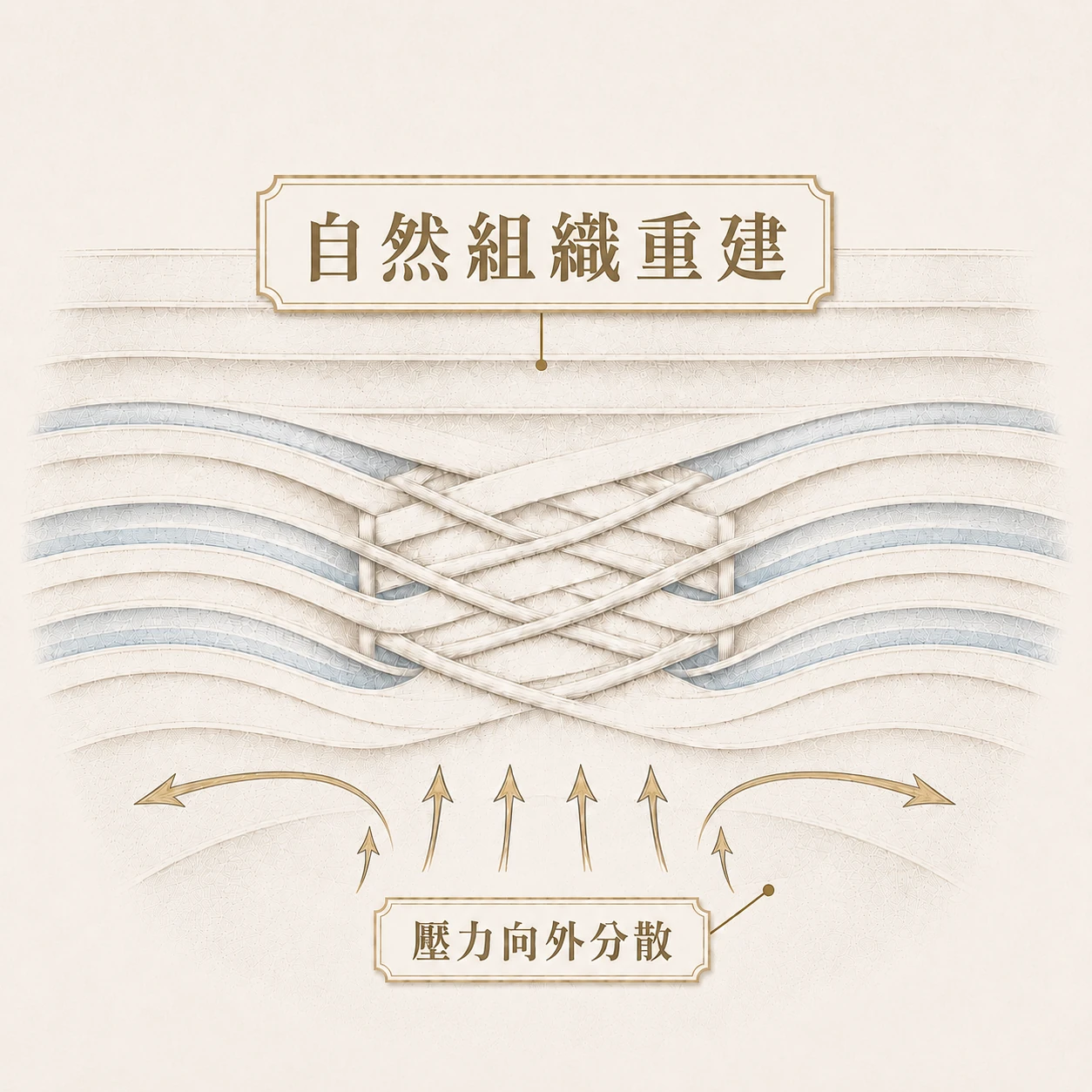
The design thinking
The abdominal wall is a multilayered tension system: the external oblique acts like a tension cable; the internal oblique provides crossed support; the transversus abdominis is the body's natural abdominal support belt; and the rectus abdominis forms the front pillars. They converge at the linea alba to form a central main beam, together dispersing the pressure of coughing, lifting, and prolonged standing. A hernia results when this system develops a long-term tension imbalance at naturally more vulnerable sites such as the groin or umbilicus — not simply when a gap appears in the interwoven muscle and fascia and lets abdominal organs protrude. There are several ways to address this structural defect. Mesh repair is the most widely used method and has been the mainstream option for more than two decades, with mature clinical evidence and well-defined indications. Natural-tissue reconstruction (Integrative Herniorrhaphy) re-layers, repositions, and reweaves the inherently stronger, more slowly degenerating structures around the groin — such as the rectus sheath, iliopubic tract, and transversalis fascia. It retensions and overlaps the tension-cable, crossed-support, and abdominal-support-belt functions described above, restoring the abdominal wall's load-bearing mechanics without using synthetic mesh. This approach is not right for everyone. Whether it is suitable, and whether it would be recommended, depends on each patient's abdominal-wall condition, prior surgical history, and overall health. The actual choice is made together with your physician after a clinic evaluation. A full account of why Dr. Alpha Lin chooses this direction, and of the biomechanical thinking behind it, is provided to the right.
Comparing the techniques
Inguinal hernia abdominal-wall repair
By surgical route, hernia repair falls broadly into "anterior (open)" and "posterior" approaches. Below is a summary of common techniques, their incisions, anesthesia, and length of stay, to inform your clinic discussion. Recurrence risk varies with defect size, tissue condition, technique design, and the surgeon's experience; no single figure applies to everyone. Please rely on a clinic evaluation and the operating surgeon's explanation.
Shared characteristics of posterior repair
This summary reflects approaches commonly described in the literature. Actual incision size, anesthesia arrangements, and recurrence risk vary with individual condition, the technique selected, and the surgeon's experience. Whether a technique is suitable should be determined through a clinic evaluation and the operating surgeon's explanation; this table alone should not be used to compare techniques' merits.
Design dimensions
A healthy abdominal wall is less like a static wall and more like protective gear that works on its own: layers of muscle overlap and tighten automatically the moment you cough or lift something heavy, spreading the pressure away. When a hernia develops, this protection gives way at the site of the defect. What this operation does is retension and re-overlap that built-in protective mechanism, using your own tissue. Below are the three directions we care about most when designing the repair.


When healthy, the muscles near the groin contract and press down like window blinds closing, sealing off this naturally weaker passage. The operation retensions this loosened layer with overlapping sutures, aiming to let the area clamp shut on its own again when you cough or strain.

The deepest layer of the abdominal wall is a muscle called the transversus abdominis, which works like a built-in corset — tightening a step ahead, before you exert force, to help steady the pressure inside the abdomen. Rebuilding this layer brings that stabilising helper back.

Down the very middle of the abdomen runs a straight, tough band of tissue (the linea alba) — like the ridge beam of a house, connecting the muscles on both sides. The operation rebalances the pull from the two sides, so that when you strain, force spreads evenly along its original paths instead of piling onto a single weak spot.
Dr. Alpha Lin has written a long essay from a biomechanical standpoint, explaining why — when conditions are right — he prioritizes the natural-tissue reconstruction direction.
From evaluation to follow-up
Each patient's actual pathway is fine-tuned to their situation; below is the typical sequence.
Briefly describe your symptoms and background via WhatsApp. The clinic will arrange a suitable appointment time.
Through history-taking, physical examination, and ultrasound where needed, the physician confirms the hernia's location and size, checks for accompanying conditions, and discusses the available approaches.
Full pre-operative explanation, testing, and education — including anesthesia assessment, pre-op precautions, and medication planning.
Performed under local anesthesia with IV sedation, with the reconstruction tailored to your abdominal-wall structure. Operating time varies with each case.
Depending on recovery, most patients can return home to rest the same day; follow-up is scheduled to your individual recovery pace. You can reach us via WhatsApp with any questions.
Surgery is performed under local anesthesia combined with IV sedation. IV sedation is a lighter form of sedation, monitored throughout by an anesthesiologist; pain during the procedure is minimal, and most patients have no clear memory of the surgery while still breathing on their own, with no need for intubation.
This anesthesia approach suits many situations, but it still requires an anesthesiologist to assess each individual case (including cardiopulmonary function, allergy history, comorbidities, and medications). For some patients, general or regional anesthesia may still be the more appropriate option.
A small number of complex cases — large abdominal wall hernias, large intra-abdominal incisional hernias, diaphragmatic hernias, or assessment for removal of previously placed mesh — require working inside the abdominal cavity, and a robotic system such as Da Vinci may be brought in. Those operations require general anesthesia with intubation and a larger pneumoperitoneum, so the prerequisites and trade-offs differ from the minimally invasive approach described above. On when it applies, see: Robotic hernia surgery — when do we use the Da Vinci system?
The following is the typical sequence for most patients. Actual recovery varies with individual circumstances, lifestyle, and type of work — please follow your operating surgeon's post-operative instructions:
Bringing clear questions to the clinic makes the discussion more productive:
The actual decision is made by you and your physician together, once you fully understand the options and your own situation.
FAQ
Next step
Everyone's abdominal-wall condition, lifestyle, and overall health is different. The most direct way forward is to arrange a clinic visit so the physician can assess you in person, then discuss the suitable options for your situation.
Taipei: 7F, No. 276, Sec. 2, Jianguo S. Rd., Taipei
Dr. Alpha Lin's Credentials
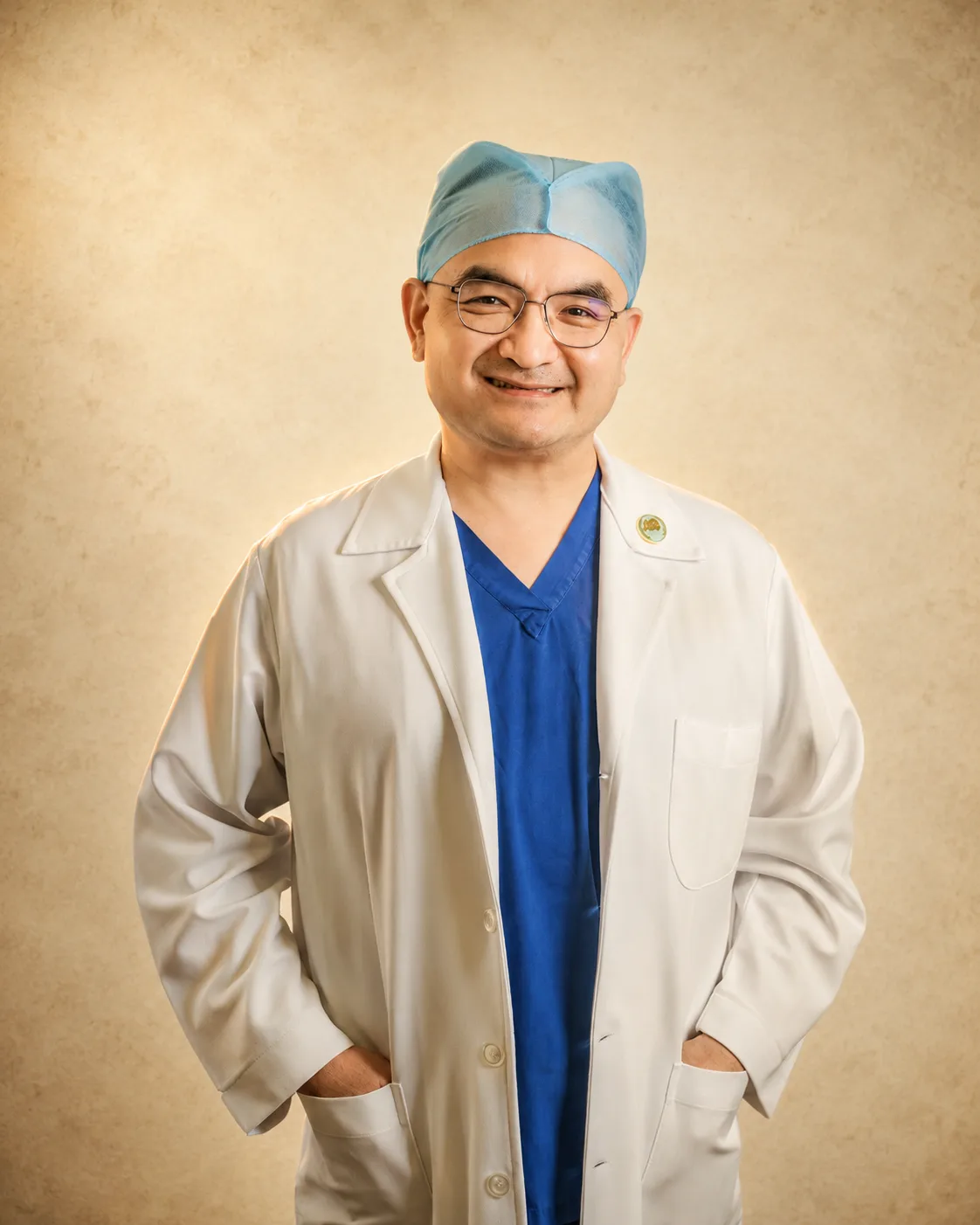
Dr. Alpha Lin
Attending Urologist, Tungs' Taichung MetroHarbor Hospital · Director, Joshua Clinic
Current Positions
Research & International Credentials
Board Certifications & Academic Appointments
Individual outcomes vary based on hernia type, tissue quality, and overall health.