"Doctor, why don't you use mesh?"
I hear that question in my clinic almost as often as "will it come back?" And every time, I pause to think: how do I put this so the person in front of me truly understands my reasoning?
Let me start by reframing the question. Strictly speaking, my answer isn't "I don't use mesh." It's "very few hernias actually need it." The two statements sound almost identical, but the logic behind them is not. Synthetic mesh isn't a patch that replaces tissue over a hole — properly used, it's sandwiched between layers of muscle and fascia, reinforcing them rather than substituting for them.
The first framing avoids a decision. The second makes one: choosing, between two design philosophies, whichever suits a given patient better. Mesh repair is a mature, well-proven technique, and often the right tool for the job. I haven't abandoned it. But under certain conditions, my thinking defaults to a different approach first.
That approach is reconstructing the abdominal wall's structural layers using the patient's own tissue.
I call it a design philosophy rather than a technique because closing the gap was never really the point. To me, the goal of hernia repair is restoring the abdominal wall to the mechanical state it's supposed to have: able to bear the ordinary stresses of daily life, flex and adapt with the body's movement, and keep doing that into the future. Reaching that goal, when conditions allow, means designing the operation from a biomechanical standpoint.
What follows is my attempt to spell out that thinking in full.
I'll walk through three biomechanical dimensions that shape my decisions. I'll also address, directly, the circumstances under which I would not take this approach — because that half of the picture matters just as much, and I don't want to bury it.
In the operating room, the material isn't what occupies most of my attention. The structure is.
The moment the question shifts from "what do we patch this with" to "how do we restore the correct mechanical structure," the whole problem looks different.
Engineers have a term for this: composite design. Any single material, however strong, eventually fatigues under repeated loading. But layer several materials together, each oriented to carry stress in a different direction, and the durability of the whole structure rises dramatically — the same principle behind carbon fiber, or plywood.
The abdominal wall was built this way to begin with. It isn't a single sheet of muscle; it's a composite of several layers of muscle and fascia, each running in a different direction, each built to resist force from a different angle. A hernia is what happens when one of those layers gives out. What occupies me in the operating room isn't patching that one layer — it's restoring the mechanical integrity of the whole composite.
That thinking breaks down into three concrete biomechanical dimensions, and echoes the work of Bert Fung, a leading figure in modern biomechanics.
Why layered structures outlast single ones
I think of the Shouldice technique as a study in distributing stress across multiple layers.
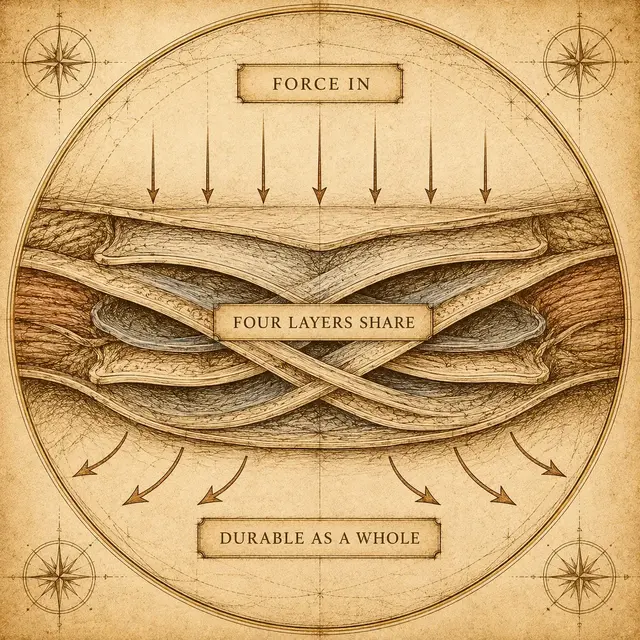
Its core move is suturing the posterior wall of the inguinal canal into four overlapping layers. These aren't four copies of the same repair stacked on top of each other — each layer is sewn under its own tension, in its own direction, sharing the load with the others. The effect mirrors composite design: no single layer bears the full force alone, because the stress is spread across the entire structure.
That matters because the groin absorbs force constantly, and from every direction — coughing, climbing stairs, twisting, lifting something heavy. Surviving that kind of daily wear doesn't call for a structure that's strong along one axis and weak along the rest. It calls for a composite that can absorb stress from all of them.
There's a second property I care about: the body's own tissue can remodel itself. Living tissue keeps renewing and reshaping. When natural tissue heals under the right tension, it doesn't simply form a passive scar — it reorganizes its fibers in response to the mechanical forces it experiences, so that, over time, the repaired area behaves more and more like the tissue around it.
That capacity for active adaptation is one of the things I weigh most heavily when designing a repair.
The abdominal wall isn't a wall — it moves
I don't think of the abdominal wall as a static barrier. It's a dynamic system, built from the start to move with the body's breathing and motion.
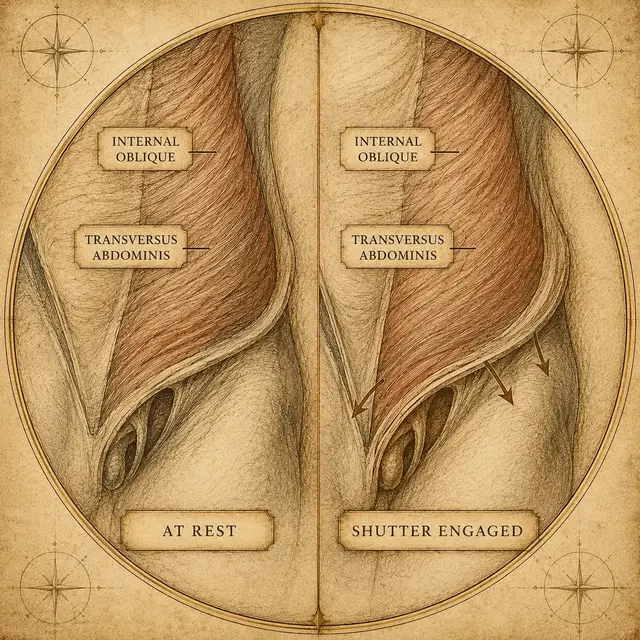
There's an anatomical detail I like to point to: the inguinal canal has what's known as a "shutter effect." When the internal oblique and transversus abdominis muscles contract, their curved lower edges sweep down and outward, closing over the top of the canal like a shutter. It's a built-in, dynamic defense against rising abdominal pressure — the instant the body strains, this mechanism engages, reinforcing precisely the spot where the body is naturally weakest.
Whether that mechanism keeps working after surgery depends on something engineers call compliance matching.
"Compliance," in mechanical terms, describes how readily a material deforms under load. Compliance matching means the repaired tissue's mechanical properties need to stay in step with the tissue around it — neither too stiff nor too soft, flexing in time with the abdominal wall rather than against it.
It's one of the things I pay closest attention to when evaluating a repair. When natural tissue is sutured into the correct anatomical position, under the correct tension, its capacity to integrate into the abdominal wall's dynamic system is central to how I think about the operation.
I favor compliance matching because I believe the abdominal wall's dynamic function deserves to be part of the design from the outset — not treated as an afterthought to a static covering. That's a statement about my own priorities, not a criticism of any other approach.
Rebuilding how force flows, not covering what broke
Through the lens of tensegrity, the abdominal wall is a tension-continuous system: its parts are linked by pathways that transmit force, and that force moves fluidly through the whole structure instead of pooling at any one point.

The inguinal ligament and the conjoint tendon act as the system's key anchor points. How well tension holds between them determines whether force can move cleanly across the rest of the abdominal wall.
A hernia isn't simply a hole. It's the sign of a force line that has been cut — the gap is where the flow of force breached its banks.
What I focus on isn't covering that breach. It's re-establishing tension continuity between the inguinal ligament and the conjoint tendon, so the repaired structure can resume its job of carrying force — letting it travel the correct path through the abdominal wall, rather than rerouting or pooling somewhere it shouldn't.
This idea — force-line reconstruction — sits at the center of how I design an operation. To me, a successful repair isn't measured by how thick the scar is. It's measured by whether the force is flowing where it should.
That logic is why, when conditions allow, I favor rebuilding this tension system with the patient's own tissue rather than simply layering something over the defect. Biomechanics, after all, is the foundation modern tissue engineering is built on.
A curious lead: stem cells from the hernia sac itself
I want to say a word about where research on mesenchymal stem cells stands in hernia repair.
Current work looks at how these stem cells regulate matrix remodeling during tissue repair, and at whether a patient's own stem cells can be cultured on biological scaffolds. I find it genuinely interesting — the thinking behind it overlaps with the idea of active tissue adaptation that already shapes how I design surgery.
But I want to be precise about where things stand: this is still research, not practice. It isn't a routine option for any patient today. The clinical evidence for using mesenchymal stem cells in hernia repair remains preliminary, and there's real distance left before it becomes standard care.
I raise it not to suggest my own operations involve anything experimental, but to be transparent about a field I follow closely. That reading informs how I assess individual patients, even though it isn't, in itself, something I offer any of them yet.
Regenerative medicine is a direction I'm watching — not an answer I have today, but one worth keeping an eye on.
The decision belongs in the clinic
I've written all this biomechanics out not to persuade anyone to choose a particular technique.
My starting point in writing this article is to let anyone who wants to understand more see my decision logic — why, under certain conditions, I lean toward natural-tissue reconstruction. This is transparency, not a sales pitch.
Every hernia patient's situation is different. Defect size, hernia type, whether it's recurrent, the patient's overall physical condition, the quality of the abdominal-wall muscle, lifestyle and type of work — these are all dimensions I assess in clinic. No single technique suits everyone, and no single philosophy is correct under all conditions.
What I care about is making the design choice I believe is most suitable for this patient, based on their real situation in front of me.
If, after reading this, you have some understanding of the design logic of natural-tissue reconstruction and more thoughts about your own situation, then the clinic is where we work through these questions together. You come with your questions, I come with my assessment of your situation, and together we decide which path is more suitable.
This is what I hope medical decision-making should look like: a discussion together, not a conclusion I hand down on my own.