
What is a varicocele?
A scrotum that looks like a bag of worms
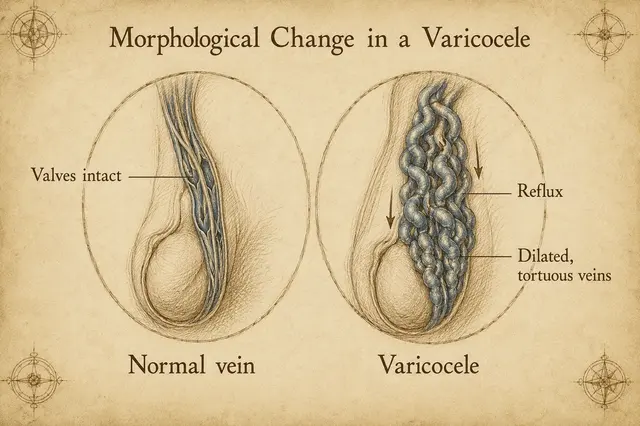
Put simply, a varicocele is an abnormal dilation of the veins in the spermatic cord within the scrotum.
The typical symptom is a heavy, dragging sensation or a dull ache in the scrotum — most often on the left side — that appears after prolonged standing or exercise and may ease after lying down to rest. On inspection or palpation, you may notice a soft, distended, rope-like cluster that feels like a tangle of earthworms. Clinically, this is described as a "bag of worms."
Why does a varicocele develop?
To understand the problem, it helps to start with the anatomy of the spermatic cord.
What is the spermatic cord?
Here's a piece of trivia first — the testes actually "migrate" down from inside the abdomen.
The spermatic cord is a paired structure unique to males. During fetal development, the testis descends from around the level of the kidney, down through the abdomen and pelvis, and through the inguinal canal into the scrotum. Along this path it brings with it the artery, veins, nerves, lymphatic vessels, and the vas deferens that supply it, gathering structures such as the cremaster muscle along the way. This whole rope-like bundle running from top to bottom is the spermatic cord.
What the spermatic cord does:
- Provides blood supply, lymphatic drainage, and nerve supply to the testis, epididymis, and vas deferens
- Helps keep the testis at an environment around 2°C below core body temperature
- Maintains smooth venous return from the testicular veins
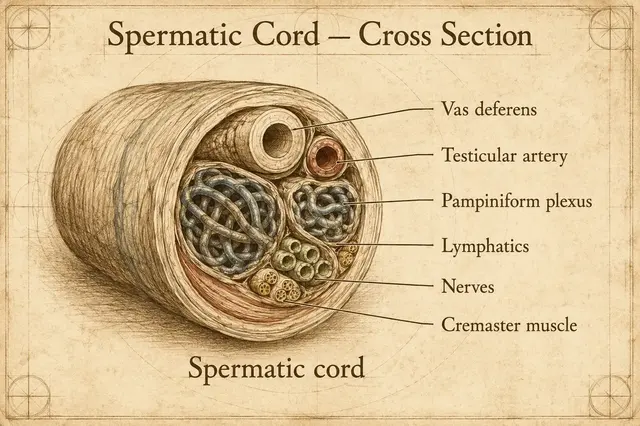
When venous return through the spermatic cord is impaired, the temperature inside the testis can rise, carbon dioxide can accumulate in the blood, and the tissue can become relatively oxygen-deprived — all of which may affect testicular metabolism. Clinically, more severe cases have been associated with impaired sperm production, but this varies considerably between individuals; not every patient is affected this way.
Venous valves: the gates that work against gravity
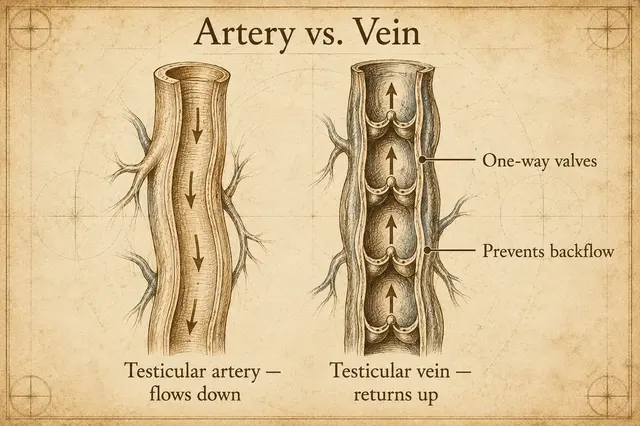
Because the testis sits outside the abdominal cavity, the testicular veins don't benefit from the abdominal pressure or muscular squeezing that helps return blood from veins inside the abdomen or the thigh. Evolution's solution is a design that assists venous return: venous valves.
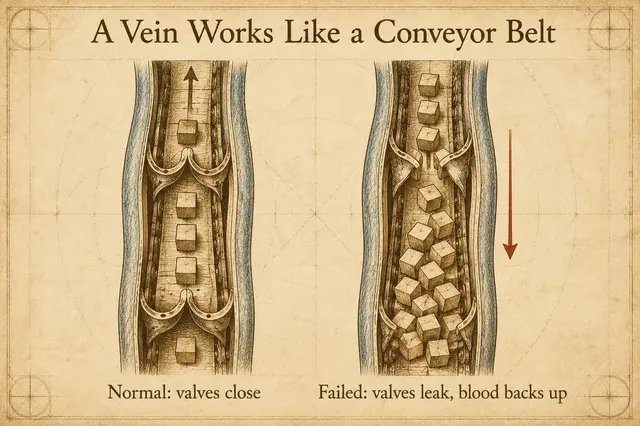
Think of a vein as a conveyor belt, with venous blood as the cargo on it. To work against gravity and keep moving the cargo (blood) upward toward the larger vessels without sliding back, the belt is fitted with "gates" (valves) — they open to let cargo pass upward and close to stop it from slipping backward.
The three main causes of a varicocele
Back to the core question: why do the veins of the spermatic cord back up and become dilated? Clinically, this usually relates to the following three factors.
1. Backflow pressure at the high junction point
As blood from the testicular vein travels upward to the left renal vein on its way into the inferior vena cava, the left renal vein has to receive blood from the left kidney, the left adrenal gland, and the testicular vein all at once — like three conveyor belts merging into one main line, sharply increasing the volume.
Blood from the left kidney and left adrenal gland mostly enters from above or horizontally, while blood from the left testicular vein joins vertically from below. The difference in direction and pressure at this junction means blood from the left testicular vein can readily face backflow pressure, and sometimes reflux — at which point the venous valves are what resist gravity and pressure.
In addition, the left testicular vein is about 8–10 cm longer than the right, so it carries a higher hydrostatic pressure to begin with. This is the basic structural reason varicoceles occur more often on the left side.
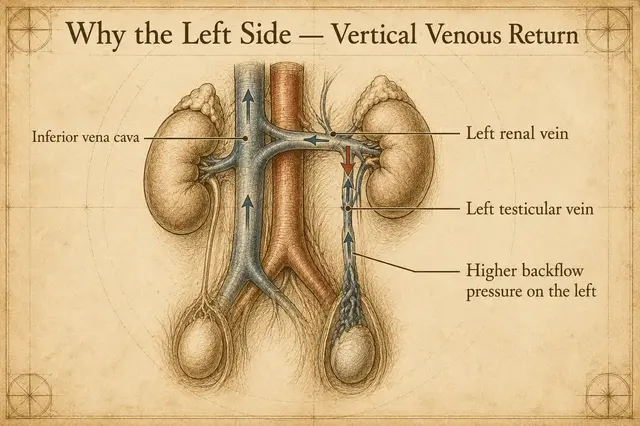
2. The "nutcracker effect": the left renal vein caught between two arteries
Before it drains into the inferior vena cava, the left renal vein has to pass through the angle formed by the aorta and the superior mesenteric artery (SMA). In a small number of people this angle is naturally narrower, and the left renal vein ends up pinched between the two arteries like a nutcracker, raising the return pressure. This is the "nutcracker phenomenon."
When there's congestion upstream, the downstream left testicular vein naturally has an even harder time returning blood — another reason left-sided varicoceles are more common than right-sided ones.
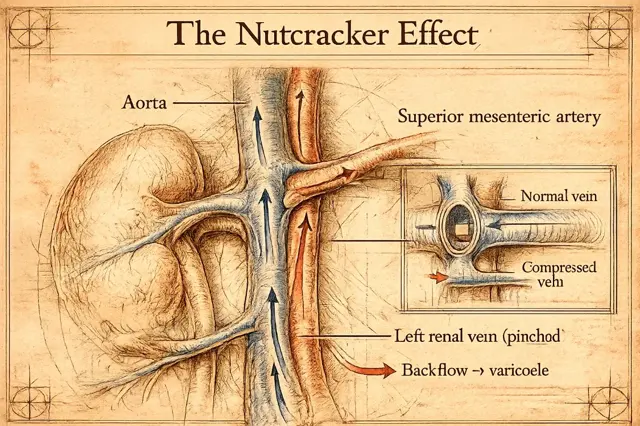
3. Incompetent venous valves
Healthy testicular venous valves open as blood is carried upward and close tightly when it would flow downward, preventing backflow.
But in some people the valve structure is congenitally weaker, or it endures excessive reflux pressure over a long period, so the valves can no longer close completely. Once blood starts flowing backward, it accumulates over time in the "pampiniform plexus" (so named because it resembles climbing vines) and the spermatic veins, causing the veins to dilate and deform — which is exactly the "bag of worms" appearance we see and feel in the scrotum.
A less common cause: the influence of intra-abdominal pressure
In rare cases, a varicocele is secondary to another problem inside the abdomen — for example an abdominal tumor, bleeding, or high inferior vena cava pressure caused by liver cirrhosis. This kind of varicocele usually appears acutely or over a short period and often comes with other systemic symptoms (such as leg swelling or scrotal edema). It calls for further investigation to find the underlying cause.
Key takeaways
- A varicocele is a dilation and deformation of the spermatic veins inside the scrotum, with a characteristic "bag of worms" appearance
- Common symptoms: a dragging, heavy sensation in the scrotum and a dull ache after standing for a while, most often on the left side
- Left-sided anatomy (the left renal vein, the nutcracker effect, and valve function) makes the left side more commonly affected
- Three main causes: backflow pressure at the high junction, the nutcracker effect, and valve incompetence
- In a minority of cases it may be secondary to another intra-abdominal condition and warrants further investigation
A final word
If you feel a "bag of worms"–like cluster in the scrotum, or notice a clear dragging sensation after standing for long periods, it's worth being evaluated at a urology or general surgery clinic. Whether anything actually needs to be done — and how — depends on your individual situation, the severity of symptoms, and the impact on daily life, and is decided after discussion with your physician.